Forces, Moments and Reactions
Moments
A moment is a turning force around a fixed pivot. If something is balanced, the moments are equal and opposite. The size of a moment is determined by the force (N) and distance (m). The distance is the perpendicular distance from the pivot to the force.
Types of connections and force modeling
A pin connection transfers vertical and horizontal shear loads and bending or moments/rotational forces. A bicycle chain is an example of pin connections.
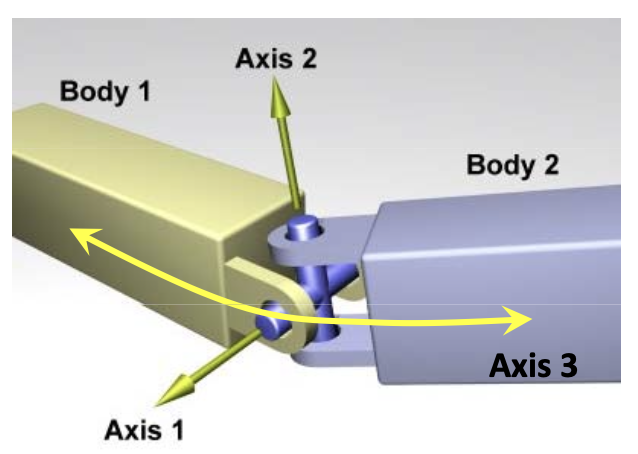
Universal joints are pin connections offset by 90 degrees. In a universal joint, forces are transmitted along axis 1, 2, and 3. Moments are transmitted along axis 3 only. The system is free to rotate along axis 1 and 2.
A roller/slider connection resists and transmits horizontal and vertical forces???
A roller/slider connection can be built in conjunction with a pin connection.
A fixed/cantilever/weld connectoin resists/transmits all 3 forces and moments. For example, welds on a bike frame, posts on a concrete pier.
A ball and socket connnection resists/transmits all 3 translational forces (F_x, F_y, and F_z) and permits all 3 rotational moments (M_x, M_y, M_z).
Cables / Wire Rope
Cables transmit axial loads in tension with no resistance to compression or bending.
For a given tensile load, δ_cable > δ_solid bar of the same material wires in the cable ‘tighten up’.
SOmething someting effective modulus and effective area.
Releases
A release can be thought of as the "anti-support." It is not designed to resist or transmit a certiain load type. Types of releases include axial, shear, flexural moment, and torsional moment releases.
Bridge exxpansion joint.
Internal releases do not transmit the type of force they are designed to release. They allow beams to expand and contract under temperature changes and avoid thermal stress. At a point of release, the force type is zero. Eg. for axial release, N, the internal normal force, = 0
Support Types and Reactions
2D
- smooth surface - one force acting normal to the surface
- rope/cable - one colinear force acting along the axis of the rope or cable
- link - one colinear force acting along the axis of the link
- roller - one force acting normal to the surface on which the roller rests
- fixed collar - one force acting perpendicular to the sleeve and one moment
- pin - two force components acting parallel to the coordinate axes
- fixed - two force components acting parallel to the coordinate axes, and one moment
3D
- smooth surface - one force acting normal to the surface
- rope/cable - one colinear force acting along the axis of the rope or cable
- roller - one force acting normal to the surface
- bearing (circular shaft) - two force components acting parallel to the coordinate axes and two moments perpendicular to the axis of the bearing
- hinge - three force components acting parallel to the coordinate axes and two moments perpendicular to the axis of the bearing
- fixed - three force components acting parallel to the coordinate axes, and three moments perpendicular to the axis of the bearing